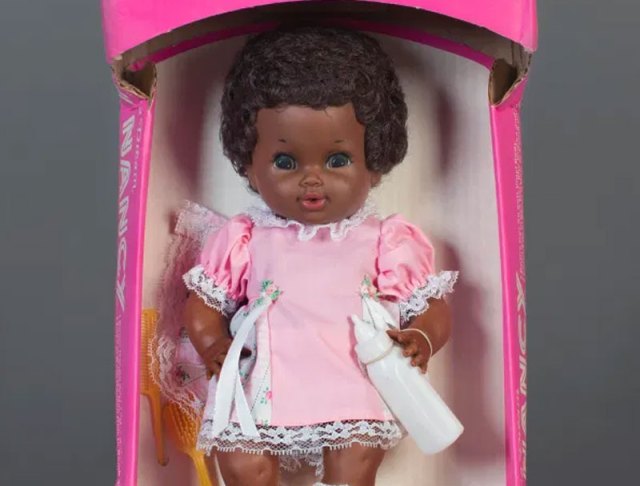
“In 1968, Shindana Toys introduced Baby Nancy, a Black baby doll designed to reflect the features, complexion, and natural hair of Black children.
At the time, many mainstream toy manufacturers offered limited representation. Some Black dolls were simply existing white doll designs with darker skin, without accurately reflecting Black facial features or hairstyles.
Shindana wanted to change that.
Founded by civil rights activists Louis S. Smith II and Robert Hall, the company was established as part of Operation Bootstrap, a community development initiative in Watts, Los Angeles.
Its mission went beyond making toys. It aimed to promote Black pride, create employment opportunities for Black residents, and reinvest profits into the community.
Baby Nancy became an extraordinary success.
The doll reportedly sold approximately 15,000 units within its first three months. By 1969, Shindana had produced around 130,000 dolls, reaching children across the United States, New Zealand, Australia, Japan, and Europe.
But perhaps its greatest achievement was what it represented.
For the first time, many Black children could walk into a toy store and find a doll that reflected their own features, skin tone, and natural hair.
Shindana eventually expanded into an extensive collection of Black dolls, action figures, games, and other toys. Its influence helped challenge the industry’s narrow ideas of beauty and representation.
The company closed in 1983, but its legacy lives on. In 2020, Baby Nancy was inducted into the National Toy Hall of Fame.
Because representation matters, even in the toys a child holds, loves, and grows up playing with.
Source: @blackhistoryunlocked
Historical references: The Strong National Museum of Play, PBS SoCal, and USC Libraries.”