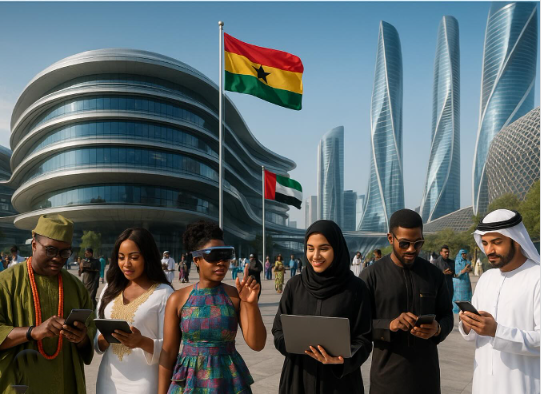
Ghana has entered into a landmark $1 billion agreement with the United Arab Emirates (UAE) to develop the Ghana-UAE Innovations and Technology Hub in Ningo-Prampram, Greater Accra. This initiative aims to position Ghana as a leading digital and artificial intelligence (AI) hub in West Africa.
Key Highlights of the Agreement
🇬🇭 Signing Ceremony: The Memorandum of Understanding (MoU) was signed on May 29, 2025, in Accra by Ghana’s Minister for Communication, Digital Technology, and Innovations, Samuel Nartey George, and Sultan Ahmed Bin Sulayem, Chairman of the UAE’s Ports, Customs and Free Zone Corporation (PCFC).
🇬🇭 Project Scope: The first phase will cover a 25-square-kilometer area in Ningo-Prampram. The UAE’s PCFC will fully fund the project, while the Government of Ghana will provide the land.
🇬🇭 Infrastructure and Facilities: The hub will feature AI engineering centers, business process outsourcing (BPO) and knowledge process outsourcing (KPO) facilities, data centers, and smart infrastructure powered by renewable energy.
🇬🇭 Job Creation and Training: The project is expected to create thousands of high-skilled jobs. It will also support Ghana’s One Million Coders Programme, aiming to train youth in AI, cybersecurity, data protection, and data governance.
🇬🇭 Global Partnerships: The hub is anticipated to attract over 11,000 companies under PCFC, including global tech giants such as Microsoft, Oracle, Meta, IBM, and Alphabet, establishing their African headquarters in Ghana.
Minister Samuel Nartey George emphasized that the hub represents a bold ambition grounded in mutual respect and a shared understanding that digital transformation is essential. He noted that the initiative aligns with President John Dramani Mahama’s vision of transforming Ghana into Africa’s next AI hub through innovation-led and inclusive development.
Sultan Ahmed Bin Sulayem highlighted that in today’s world, national wealth is defined not by natural resources but by the ability to generate and scale ideas.
Construction is scheduled to commence in 2026, with the first phase expected to be completed by the end of 2027.
Tech Africa News
Ghana Business News